

Specification
System Design
The OscilloGel system is engineered as a synthetic DNA-crosslinked hydrogel, designed for high-precision morphological control. The backbone of the hydrogel consists of polyacrylamide, which provides the necessary structural integrity and biocompatibility. Crucially, the functional responsiveness of the gel is encoded into the crosslinking network using specific DNA sequences.
The system is composed of two primary components: the structural polyacrylamide polymer chains and the DNA duplex crosslinkers that bridge these chains. One of the DNA strands in the crosslinker is permanently anchored to the polymer backbone through a covalent bond. The other strand, which acts as the crosslinking agent, is hybridized to the anchored strand to form a stable duplex. By varying the length and the sequence composition of these DNA crosslinkers, we can tune the physical properties of the gel, such as its stiffness and its initial swelling ratio.
This design enables a programmable transition between different physical states. When a specifically designed trigger DNA strand is introduced into the system, it interacts with the DNA crosslinker via a toehold-mediated strand displacement mechanism. This reaction results in the de-crosslinking of the gel network, leading to a rapid and reversible change in its volume, such as swelling or shrinking.
The modular nature of this system allows for fine-tuning based on the desired application. The mesh size, the degree of swelling, and the sensitivity to the trigger concentration can all be adjusted by altering the DNA sequence designs and the crosslinking density. This structural design ensures that the hydrogel acts as both a sensor and an actuator, directly converting the biochemical signal of DNA hybridization into a tangible mechanical response at the microscale.
Mechanism
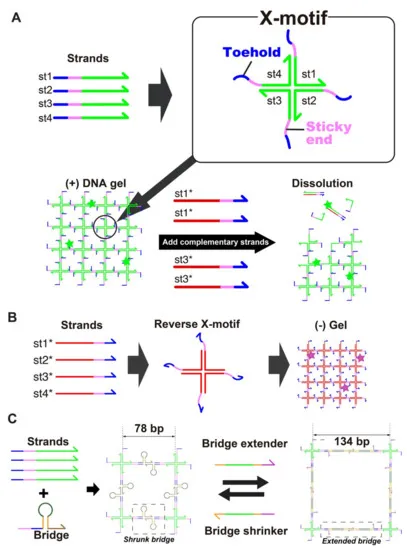
The core mechanism of our hydrogel actuation relies on toehold-mediated strand displacement, which acts as a molecular switch for the crosslinking density. The DNA crosslinker in our system consists of two hybridized DNA strands: the anchor strand, which is covalently attached to the polyacrylamide backbone, and the complementary linker strand, which holds two different polymer chains together.
When a specific trigger DNA strand is introduced, it binds to a short, single-stranded overhang on the linker strand, known as the toehold. Once bound, the trigger strand initiates a branch migration process, which progressively replaces the anchor strand from the duplex. This leads to the release of the linker strand from the anchor strand, effectively breaking the covalent connection between the polymer backbones.
As the crosslinks are dissociated, the osmotic pressure within the hydrogel network overcomes the elastic retraction force of the polymer chains, resulting in the rapid swelling of the gel. Conversely, if a removal strand—designed to be complementary to the trigger DNA—is introduced, it can sequester the trigger DNA via a secondary strand displacement reaction. This allows the anchor and linker strands to re-hybridize, restoring the crosslinks and causing the gel to contract back to its original state.
This process is highly programmable and reversible, allowing us to modulate the mechanical state of the microgel by simply adjusting the concentration and sequence of the trigger DNA inputs. The kinetics and thermodynamic stability of these reactions are precisely defined by the length of the toehold and the GC content of the DNA sequences, providing a robust platform for microscale mechanical control.