



Future Work
Future Experiments
Autonomous Hydrogel Integrating DNA Networks and Environmental Sensing
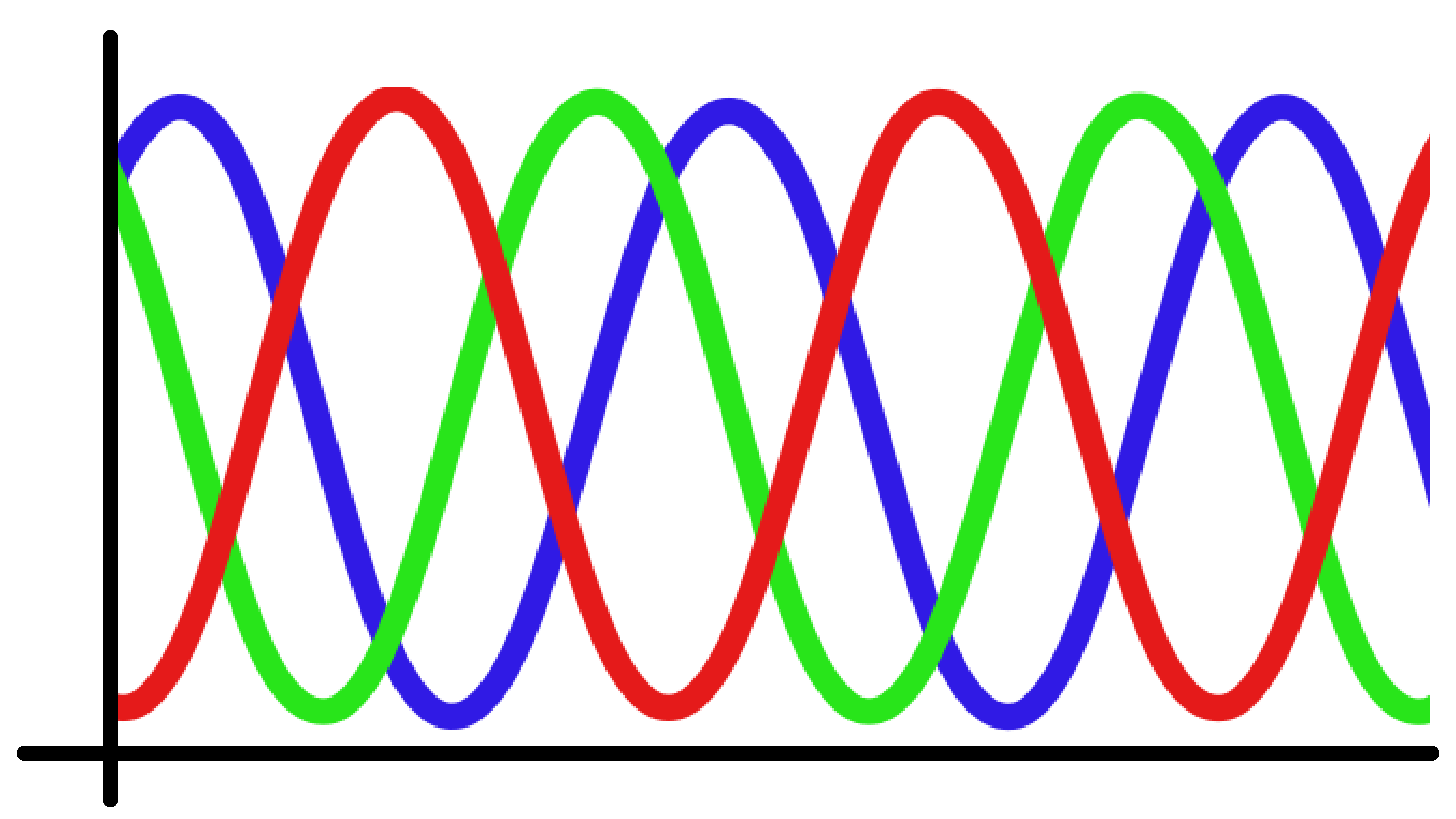
1. Construction of an Autonomous Oscillatory DNA Reaction Network for Hydrogel Actuation
We aim to extend the PEN DNA toolbox developed in this project to establish an autonomous oscillatory DNA reaction network using Polymerase, Exonuclease, and Nickase.
By periodically regulating Signal DNA and Linker DNA concentrations, we aim to control DNA crosslinking in PAAm hydrogels and achieve repetitive swelling and shrinking without external periodic stimuli.
Ultimately, we aim to develop self-actuating hydrogels driven by autonomous molecular reactions.
2. Integration of an Aptamer-Based Environmental Sensing Mechanism
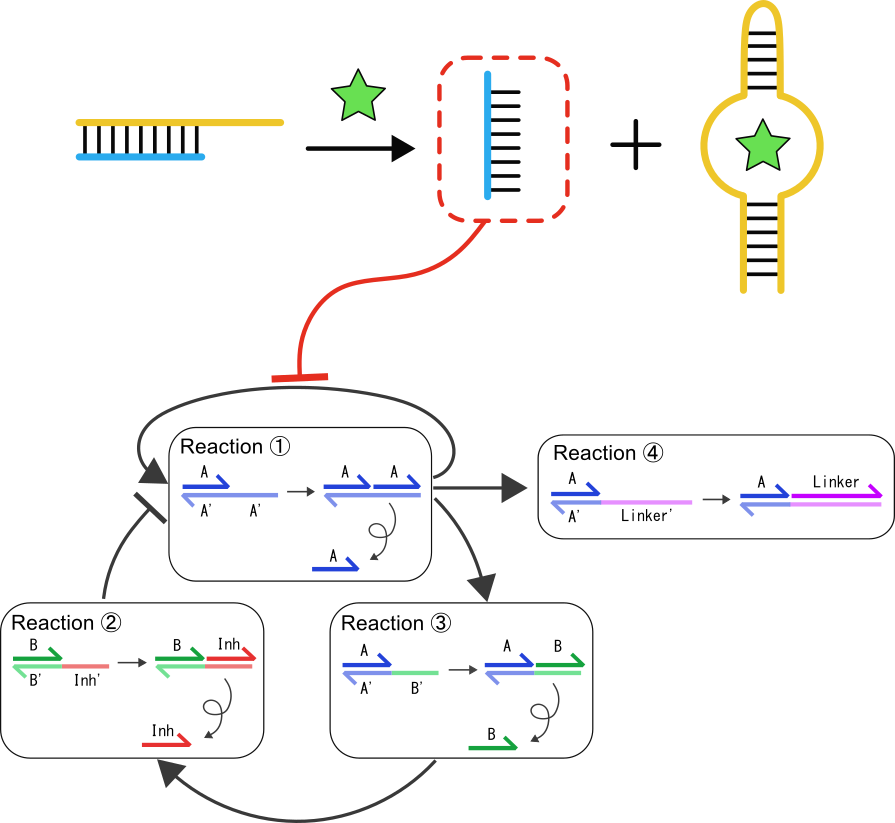
We aim to incorporate aptamers into the DNA reaction network to enable the hydrogel to detect environmental signals and regulate its mechanical behavior accordingly.
Aptamers are DNA or RNA sequences that specifically bind to target molecules. By coupling aptamer-based molecular recognition with the DNA reaction network, environmental signals can be converted into changes in reaction network activity.
For example, target molecule binding may activate or inhibit specific DNA reactions, thereby altering the oscillation period or amplitude. These changes will regulate Linker DNA production and, consequently, hydrogel swelling and shrinking.
Ultimately, we aim to develop adaptive hydrogels that sense their surrounding environment and autonomously adjust their mechanical behavior.
3. Long-Term Goal: Development of Autonomous Molecular Robots
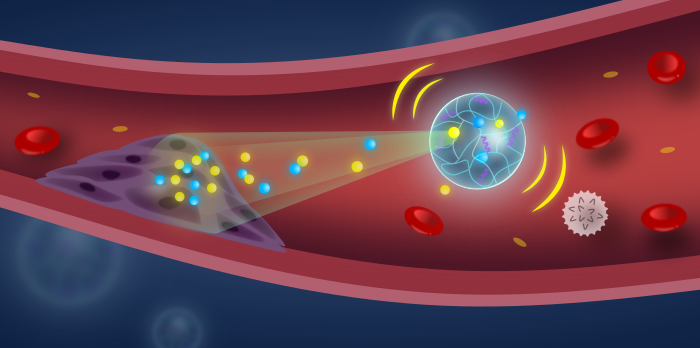
Ultimately, we aim to develop autonomous molecular robots by integrating DNA reaction networks, aptamer-based environmental sensing, and DNA hydrogel actuators.
By introducing compartmentalized structures within the hydrogel, potentially using liposomes, we aim to maintain molecular reaction networks and achieve sustained autonomous actuation.
This approach could provide a foundation for soft and molecular robots that sense their chemical environment, autonomously regulate their behavior, and actively interact with their surroundings.
Future Applications
By overcoming these challenges, DNA-crosslinked gels could be used as actuators for soft robots with diverse functions. Previous studies have reported that complex hydrogel deformations can be achieved through structural design [1]. Using this concept to DNA-crosslinked gels, connecting multiple gels with shifted swelling-shrinking cycles may enable earthworm-like locomotion. [2]. In addition, combining these gels as building blocks could lead to the development of self-oscillating robots. The robots could have various shapes depending on their intended purpose.

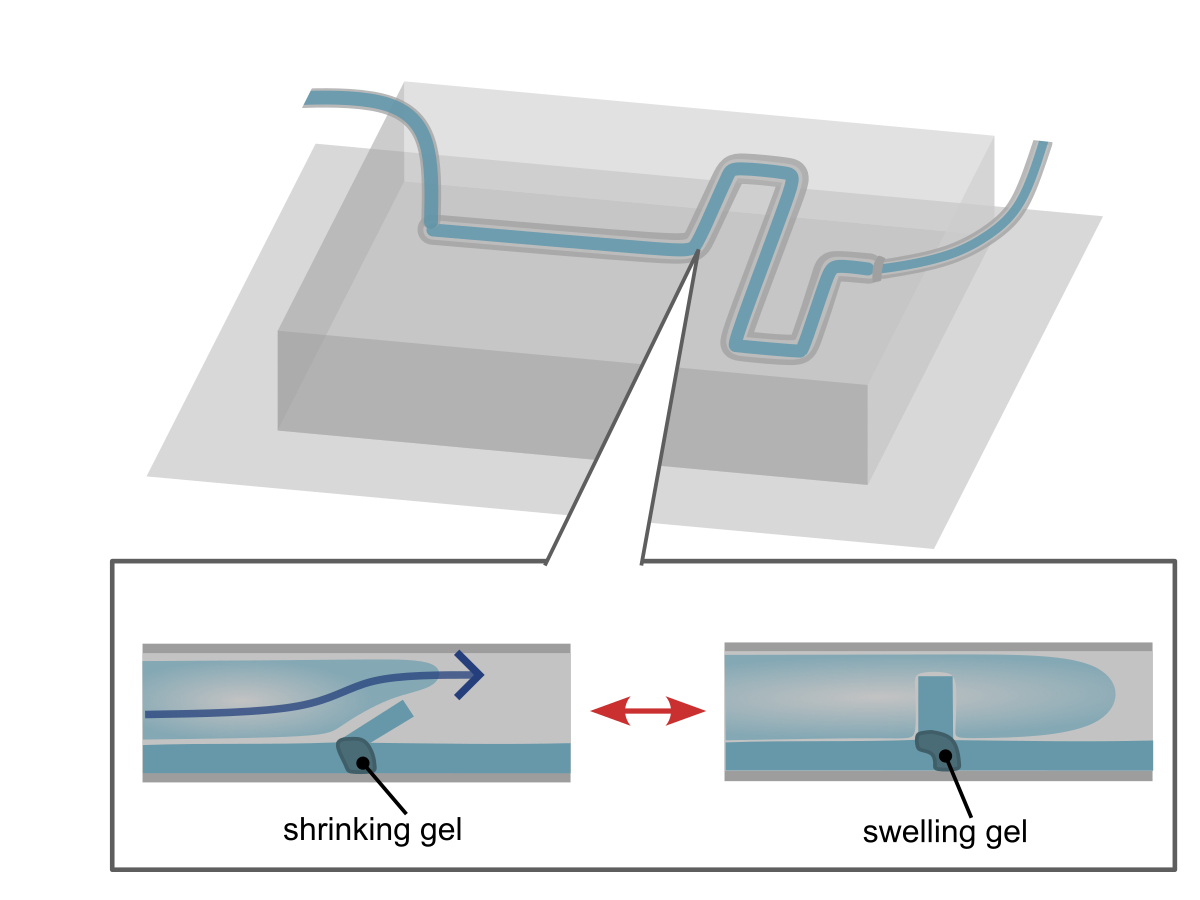
Furthermore, DNA-crosslinked gel may serve as micropumps when incorporated into microfluidic devices. For example, self-oscillating polymer gels have been used to transport liquids through periodic volume changes [3]. Inspired by this approach, the periodic volume changes of DNA-crosslinked gels could be converted into pressure changes within microchannels, enabling fluid transport. Moreover, designing DNA reaction networks to adjust the swelling–shrinking period could provide a new approach to controlling the flow rate. However, the relationships between the oscillation period, the magnitude of gel deformation, and the volume of liquid transported need to be experimentally investigated.
In this way, DNA-based chemical reactions can be converted into periodic swelling and shrinking of gels, potentially making it possible to create autonomous systems with more complex functions [4]. These technologies are expected to contribute to the development of autonomous molecular robots and soft robots that move in response to different environmental conditions.
References
- [1] Recent Progress in Biomimetic Anisotropic Hydrogel Actuators - Le - 2019 - Advanced Science - Wiley Online Library. https://advanced.onlinelibrary.wiley.com/doi/10.1002/advs.201801584 (accessed 2026-11-10)
- [2] Shiraki, Y.; Yoshida, R. Autonomous Intestine-Like Motion of Tubular Self-Oscillating Gel. Angew. Chem. Int. Ed. 2012, 51 (25), 6112–6116. https://doi.org/10.1002/anie.201202028
- [3] Yoshimura, K.; Otsuka, Y.; Mao, Z.; Cacucciolo, V.; Okutaki, T.; Yamagishi, H.; Hashimura, S.; Hosoya, N.; Sato, T.; Yamanishi, Y.; Maeda, S. Autonomous Oil Flow Generated by Self-Oscillating Polymer Gels. Sci. Rep. 2020, 10 (1), 12834. https://doi.org/10.1038/s41598-020-69804-3
- [4] Molecular Robots with Sensors and Intelligence | Accounts of Chemical Research | ACS Publications. https://pubs.acs.org/achre4/article-abstract/47/6/1681/1247996/Molecular-Robots-with-Sensors-and-Intelligence?redirectedFrom=fulltext (accessed 2026-11-10)